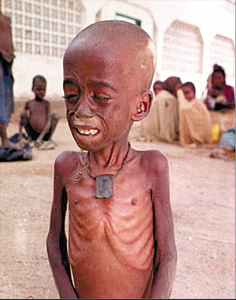
 Our mums were probably right when they told us not to waste food "cos children in Nigeria are starving". Yes they are. 6 million toddlers starve to death each year. And it's not only Nigeria. Indeed, the gross excesses of the developed world seem disgusting - even morbid - when juxtaposed against the 800 million who go to bed hungry each day (no, they don't drink glucose solution aka a particular opposition leader). While the rich splurge on cosmetic surgery to beautify their faces, 4 million 3rd-world babies die each year due to poor or nonexistent medical facilities. And just as we don't consider $2 to be a large sum of money, 1.1 billion people live on less than US$1 a day.
 The cavernous divide is staggering - Even within the developed world itself: Anton Rupert, arguably South Africa's most prominent businessman, owes a business empire and is listed among the Forbes 500 wealthiest list. Now think about the better-known face of Africa - barly clothed, skin-and-bone stick figures, with no guarantee when their next meal will be.
An abundance of causes, a dearth of solutions
It is to these stick figure occupants of dystopia that the prospect of communism seems most promising, and Bolshevik "peace, bread, and land for everyone" seems most utopian. At the very least, they yearn for some improvements to their social environment, and the provision of affordable, accessible, and quality healthcare and educational facilities. But the question is: where's the money going to come from? There are no easy answers.
Humanitarian aid is, to governments and the poor alike, seems the best solution - after all, starving people often don't look further than their next meal. But it is merely a quick fix at best - it allievates the symptom but not its root cause. And above all, it doesn't teach the poor - and their governments - to stand on their own feet, but merely become reliant and dependant on aid. But the shrinking 1st world population can't always support a burgeoning 3rd world population, and when donor fatigue sets in, or when times are less rosy, this lifeline may just be cut off.
At worst, corruption makes humanitarian aid throwing money into a bottomless pit. The cash inflows might not even reach the poor. When distributed through government channels, all it may do is fatten the wallets of some - Just take a look at Nigeria's late dictator, Sani Abacha, who lived in splendour off US$4 billion in siphoned aid dollars. The alternative of going through NGOs somehow doesn't seem appealing to governments - logically so, since it means that no funds can be diverted to swiss bank accounts.
Economic development would be a utopian solution - jobs would lift millions out of poverty. But it is a seemingly impossible one. Foreign direct investment, the usual force kickstarting economic growth until the economic engines of countries can run on their own (this requires both capital and skilled labour, among other things) , is decidedly low given the astronomical risks - a whole spectrum ranging from political instability to corruption to dismal infrastructure. Even if they do, MNCs do wreck havoc absent a government immune to bribery - they frequently exploit their workers, and indirectly harm farmers by polluting the enviroment (the textbook example being Shell in Nigeria). They allow catastrophies like the Bhopal disaster to occur - life is cheap there, isn't it?
How to make poverty history
The quintessence of the problem is probably political. The possibility of any economic development will only come with the required political framework. Especially with a giant competitor - China - for the same market segment, there is no room for corruption or complacency in the developing world. Talent, and the political will to implement whatever ideas talent brings, are the keys in lifting countries out of poverty - but only when used in unison. The sad part of the whole issue, though, is that such talented, altruistic, and determined leaders are a rarity.
With the foundation stone of economic development laid, several things need to be done. One, their resources need to be used in a rational and sustainable manner as cash cows to jumpstart the economy - be it labour, oil, timber or natural wildlife and beauty (like Chile or Botswana). Two, labour-intensive industries must be promoted via the provision of infrastructure and a efficient and effective bureaucracy and possibly government incentives. Three, to avoid further exacerbating poverty, their swelling population must somehow be controlled. Extra babies can only mean that there is less to go around. Four, once some foreign exchange has been generated, better education can and must be provided to the masses - unless countries want to keep mining metal or sewing clothes and remaining poor forever, this is the only way to add value (in terms of skill) to labour and climb up to the next rung of industry (i.e. skill-intensive).
Perhaps an accusatory finger must be pointed at the developed world as well, for their protectionist policies, unfair trade laws, and protection. We have artificially cheap US cotton swamping African nations breaking the already fragile rice bowl of these African farmers. The failure of Doha is similarly worrying, since it means that the 3rd-world's exports will continue to face sometimes insurmountable trade barriers, thus hindering their economic development - what's the use of producing so many goods when you can't get them out of your borders?
But to ask the the leader of any developed country, already facing economic stagnentation, to put millions of his farmers out of a job (and it's hard to create jobs for so many of them in the often saturated other sectors of stagnant economies) , and throw his popularity and votes out of the window, is probably asking for the moon. Even though promoting the development of the 3rd world can only benefit developed countries in the long term by serving as a growth engine and providing investment opportunities, elections, and the loss of jobs, and therefore seem more pressing. Again, selfish desire and shortsightedness jeopardises long-term common good.
That need not be the case. So do the vagaries of problems the 3rd world face. The obstacles to eradicating poverty need not be insurmountable. Political will and good ol' common sense and a dose of altruism are the keys. And they are in our hands. Are we brave enough to use them?
2nd para incorporating research from RI "RJC today" submission