Malaysian Parliment
Paid to argue while everything productive is at a standstill.
Showing posts with label Worldview. Show all posts
Showing posts with label Worldview. Show all posts
Monday, November 17, 2008
Thursday, September 27, 2007
March to freedom?
Sign this petition
March to freedom?
Riot police attack monks
Why protest?
For those who are unfamiliar with the background behind the junta: they organised a election in the early 1990s, in which aung san suu ki won, but refused to recognise this...
Sadly this is not going to be enough. International pressure is necessary before the junta will get out. Sadly, few countries are willing to take the moral high ground (e.g. Singapore, as chair of ASEAN, should do something).
More info from economist.com
In the last pro-democracy protests on this scale, in 1988, it took several rounds of massacres before the demonstrations finally subsided, leaving the regime as strong as ever. By Thursday September 27th, with a crackdown under way, and the first deaths from clashes with security forces, it seemed hard to imagine that things would be very different this time.
Myanmar’s tragic recent history suggests that when an immovable junta meets unstoppable protests, much blood is spilled.
As in the past, the world’s initial response to the junta’s violence was marked by bickering and point-scoring. On September 27th, the United Nations Security Council met in response to pressure from the West for co-ordinated sanctions. But Russia and China argued that the unrest was an internal matter that should not be on the council’s agenda at all.
If any countries can sway the junta they are the regional ones: ASEAN, especially Thailand; India; and above all China. China has given the junta diplomatic support, helping for years to keep its behaviour off the agenda of the United Nations Security Council. But Myanmar is far from a client state.
As in 1988 and 1990 the Burmese people have shown they want to choose their own leaders. In the past they did not fully reckon on the ruthlessness of the people they were up against. One day, as with all tyrannies, Myanmar’s will fall. But much blood may flow before that day dawns.
March to freedom?
Riot police attack monks
Why protest?
For those who are unfamiliar with the background behind the junta: they organised a election in the early 1990s, in which aung san suu ki won, but refused to recognise this...
Sadly this is not going to be enough. International pressure is necessary before the junta will get out. Sadly, few countries are willing to take the moral high ground (e.g. Singapore, as chair of ASEAN, should do something).
More info from economist.com
In the last pro-democracy protests on this scale, in 1988, it took several rounds of massacres before the demonstrations finally subsided, leaving the regime as strong as ever. By Thursday September 27th, with a crackdown under way, and the first deaths from clashes with security forces, it seemed hard to imagine that things would be very different this time.
Myanmar’s tragic recent history suggests that when an immovable junta meets unstoppable protests, much blood is spilled.
As in the past, the world’s initial response to the junta’s violence was marked by bickering and point-scoring. On September 27th, the United Nations Security Council met in response to pressure from the West for co-ordinated sanctions. But Russia and China argued that the unrest was an internal matter that should not be on the council’s agenda at all.
If any countries can sway the junta they are the regional ones: ASEAN, especially Thailand; India; and above all China. China has given the junta diplomatic support, helping for years to keep its behaviour off the agenda of the United Nations Security Council. But Myanmar is far from a client state.
As in 1988 and 1990 the Burmese people have shown they want to choose their own leaders. In the past they did not fully reckon on the ruthlessness of the people they were up against. One day, as with all tyrannies, Myanmar’s will fall. But much blood may flow before that day dawns.


Sunday, July 08, 2007
Democratisation of the internet
it's been a while since i posted a "content" post... and this is an interesting one i hope =)

Time magazine's "person of the year": YOU (look at the mirror)
image from gawker
We may not realise it, but each time we participate in the online community, be it blogging, adding our 2 cents worth to Wikipedia, or uploading a video to Youtube, we are contributing towards the "democratisation of the internet": the power of the internet has indeed truly been given to the people.
It is interesting, as a study of emergent properties in systems, and how bottom-up content-creation by millions or billions of individual users can vastly outdo what a top-down approach is capable of. Just look at Wikipedia, the most comprehensive resource available, and a de facto first stop for most of us when wanting to find out about something.
As an internet phenomenon the democratisation of the internet is unrivalled. Personal and social space online is free and plentiful (though fraught with dangers). The reach and the power it gives to the individual (ask mrbrown) is amazing. All is needed from the top is the infrastructure, and perhaps giving it some momentum.
There are implications, of course. First is abuse and censorship: just as people can post useful stuff online, so can the post hate speech and bomb-making instructions. And the internet is horrendously hard to censor, especially when it knows no borders.
Next is the reliability of online sources like Wiki: you probably won't want to rely on it for your thesis paper, but as general reading it is perfectly fine. The error rate is very, very low, and any errors can be corrected easily (unlike print encyclopedias: britannica got jacked when they went to look for errors in wiki, cos someone corrected the errors in 2 days).
But lim (t --> infinity), these problems will iron out. We are stepping closer to the ubiquity of information; the true age of the internet has just dawned.
P.S.
I also contribute to Wiki and Google Video (click on "more from user" in the sidebar".
I can't believe it that my atomic bomb video has 22700 views and 1230 downloads!!! Ok hopefully it has benefitted others.
Other RI wikipedians i know: Ren Yan, Joel Kek, Vincent, Jun Sean, Jeremy Sia

Time magazine's "person of the year": YOU (look at the mirror)
image from gawker
We may not realise it, but each time we participate in the online community, be it blogging, adding our 2 cents worth to Wikipedia, or uploading a video to Youtube, we are contributing towards the "democratisation of the internet": the power of the internet has indeed truly been given to the people.
It is interesting, as a study of emergent properties in systems, and how bottom-up content-creation by millions or billions of individual users can vastly outdo what a top-down approach is capable of. Just look at Wikipedia, the most comprehensive resource available, and a de facto first stop for most of us when wanting to find out about something.
As an internet phenomenon the democratisation of the internet is unrivalled. Personal and social space online is free and plentiful (though fraught with dangers). The reach and the power it gives to the individual (ask mrbrown) is amazing. All is needed from the top is the infrastructure, and perhaps giving it some momentum.
There are implications, of course. First is abuse and censorship: just as people can post useful stuff online, so can the post hate speech and bomb-making instructions. And the internet is horrendously hard to censor, especially when it knows no borders.
Next is the reliability of online sources like Wiki: you probably won't want to rely on it for your thesis paper, but as general reading it is perfectly fine. The error rate is very, very low, and any errors can be corrected easily (unlike print encyclopedias: britannica got jacked when they went to look for errors in wiki, cos someone corrected the errors in 2 days).
But lim (t --> infinity), these problems will iron out. We are stepping closer to the ubiquity of information; the true age of the internet has just dawned.
P.S.
I also contribute to Wiki and Google Video (click on "more from user" in the sidebar".
I can't believe it that my atomic bomb video has 22700 views and 1230 downloads!!! Ok hopefully it has benefitted others.
Other RI wikipedians i know: Ren Yan, Joel Kek, Vincent, Jun Sean, Jeremy Sia
Sunday, March 04, 2007
Make poverty history
Original article:
Category: social issues
Muhammad Yunus wins the Nobel peace prize for providing micro credit to the poor in Bangaladesh. The Economist discusses his achievements, as well as microfinance in general, and their impact on eradicating poverty.
Macro credit: Muhammad Yunus has won the Nobel peace prize for his role in promoting financial services for the poor
Oct 19th 2006, from the Economist print edition.
Also available online with a subscription. Click here
FOR many of the supporters of Muhammad Yunus and the institution he created, the Grameen Bank of Bangladesh, the announcement that the two will share a Nobel peace prize is long overdue—the only surprise is that it was so long in coming. Grameen's website lists 60 awards, 27 honorary degrees, and 15 other “special honours” previously received by Mr Yunus directly, and seven received by Grameen. The selection committee said the prize was for developing what “had appeared to be an impossible idea”, namely loans to people who lack collateral.
Mr Yunus has unquestionably helped create an industry that provides financial services to the poor, combining his experience of growing up in a small village with his academic background as an economist to popularise what was once just a fringe area of banking and an obscure idea about alleviating poverty. Grameen has become a sizeable institution, with 6.7m customers, most of them women and all of them poor. Grameen has, by its own reckoning, distributed $6 billion in loans, each on average less than $200. Dressed in a traditional Bangladeshi outfit made by a Grameen affiliate, the charismatic Mr Yunus, with his soft voice and warm smile, can transform the dry, grinding mechanics of banking into a bewitching story about beggars, children and empowered women, all benefiting from credit that should be a human right and could even, he says, end poverty.
Even so, loans to the poor have existed for thousands of years. The formalised system of small borrowing that Mr Yunus pushed in Bangladesh beginning in the mid-1970s was being tried in bits and pieces around the world at the same time, and earlier as well. Even in Bangladesh, where his award was warmly received as an international endorsement, there are two other equally large and innovative microfinance institutions: BRAC, which dates back to the same era as Grameen, and ASA, which came later but improved on the basic model. Yet as remarkable as these three are, to single them out is, in a sense, unfair. There are thousands of financial institutions around the world providing financial services to the very poor. It is a world of extraordinary individuals, and one that has advanced as a result of collective insights. Physics and chemistry, to cite two other Nobel categories, may be built upon the shoulders of a few giants, but microfinance needs—and has—thousands of them.
Mr Yunus and Grameen succeeded by seizing an idea, expanding quickly, proselytising and resisting the temptation to move beyond the poor. His particular approach to microfinance has not, however, been without controversy. By legend, Grameen grew out of a $27 loan Mr Yunus made in 1974 to a woman manufacturing furniture who did have credit, but at an exorbitant price. Grameen emerged soon thereafter, based on several key operational techniques: loans were made to individuals but through small groups who in effect (if not explicitly) had joint liability; the loans were for business, not consumption; and collection was frequent, usually weekly. Interest charges were significant—the money was not aid, and a fundamental tenet of Grameen is that the poor are creditworthy—but the rates were relatively low (currently just above 20%).
This approach had virtues and limitations. Low rates and lower savings (except as a back-up for repayment) meant that in its early years, Grameen relied on capital from public and private donors—something that less charismatic or connected entrepreneurs than Mr Yunus found hard to replicate. Joint liability for loans became an increasing problem for groups when some members wanted to borrow more than others. And it was unclear whether the money received really did always go to business, rather than daily needs. A deeper question is just how helpful such tiny loans really are. Heart-warming case studies abound, but rigorous analyses are rare. The few studies that have been done suggest that small loans are beneficial, but not dramatically so. A further question is whether an approach emphasising credit really can eradicate poverty: a ridiculously ambitious goal, though one that Mr Yunus's evangelical view of the virtues of credit has perpetuated. Whether this form of lending has led to peace, the presumptive reasoning behind the award, is just as big an unanswered question.
Credit where credit's due
The classic Grameen model began to fray in the 1990s and hit a wall in 1998, when a devastating flood pushed up losses and people began missing weekly payment meetings. Mr Yunus was no doubt familiar with microfinance innovations in other countries: BRI in Indonesia had transformed itself from a wreck into a huge success by emphasising savings, not credit, and other institutions had started to abandon group lending. Grameen restructured in 2001, emphasising savings (deposits now exceed loans) and relying less on joint liability for groups.
With Grameen now thriving and the Nobel on the shelf, what will Mr Yunus do next? There are persistent rumours that he might enter politics, given his prestige within Bangladesh. And this could be a good time for him to step away from microfinance, which appears to be at an inflection point. Institutions continue to emerge and grow, many funded by private capital and seeking a real return, an approach Mr Yunus opposes. They often begin by charging higher rates than Mr Yunus considers legitimate, but cut prices when their returns draw competitors—a tough but theoretically more supple model. Microfinance would also benefit from a voluntary regulatory structure to improve its access to capital, and greater use of technology to reduce transaction costs. What it needs, in short, are the boring, quiet innovations that dynamic industries depend upon, but which, alas, do not win prizes. The Nobel, and its recognition of microfinance's most charismatic cheerleader, may mark the end of an era as a more mature industry starts to emerge.
------------------------------
Personal response
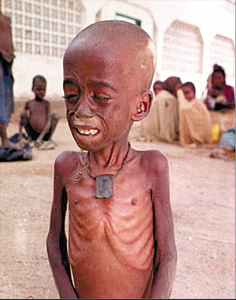 photo: The orion “Don’t waste food. The children in Nigeria are starving.” I only really understood my mum’s oft-repeated rhetoric when I saw poverty, in all its disgrace, for myself.
I was in Beijing on an exchange programme last December. One evening, as I walked down a filthy street, burying my hands away from the icy gale, in the snug comfort of my pockets, I noticed a scrawny man - with a stump for his right hand – shiver in the bitter cold in his filthy cardbox “home”. He only had a tattered (and probably scavenged) bedsheet for warmth. Hesitating, I decided he wasn’t one of those I had been warned about, and rummaged in my haversack (chock full with cheap shopping) for some shirts to offer to him. The gratitude in his eyes pierced my conscience. Hopefully, they would keep him warm.
Born into prosperity - and all its luxuries - I consider myself blessed. I know not what it is like to be poor and hungry. All I know it that it isn’t nice – and that that’s an understatement.
The root of dystopia
Looking at the affluent first world, capitalism seems to work as an economic model. But it’s far from a panacea. It causes extreme polarization. 1.1 billion worldwide subsist on less than US$1 a day (see endnote 1). The very concept of survival of the fittest, which makes capitalism successful, also makes it cruel. While the fittest survive, the rest, like that disabled man in Beijing, languish. The race to riches has sidelined many.
The poor world is also plagued with a deluge of problems – ranging from political turmoil (Bangladesh) to civil war (Iraq) and even genocide (Sudan). These only exacerbate an already dire situation via direct damage and killing off what little economic opportunities there are.
Hope of a better age
It is only right that we, on the greener pasture, emerge from our selfish disinterest and help the poverty-tormented.
But throwing money at the problem won’t work. Aid is only temporary relief; it doesn’t make the poor any richer. When donor fatigue sets in, the poor are often left to rot (see footnote 2). To reap sustainable long-term benefits, on a scale much greater than what aid can do, the poor must stand on their own two feet: they need to sort out their domestic bedlam, and develop their economy. Education is key to escaping the poverty cycle.
We should help them along. Micro-credit to the poor, as Yunus has done, is one good way to give the poor opportunities to move up the economic ladder, and kickstart the third-world economy. It would be sad if others extend micro-credit as a profiteering business – every single cent should go to the poor, not into someone’s fat wallet.
Yunus deserves his Nobel. If only others could follow his example – especially those politicians and farmers who sabotaged the Doha trade talks with their selfish demands.
The children in Nigeria deserve better. They’re humans too.
You too can help eradicate poverty. Click here.
--------------------------
English online blog of personal response to current affairs.
Portfolio submission 1 for Term 1
Nigel Fong (3C / 6)
19 February 2007
Word count: 499, excluding endnotes & bibliography.
Endnotes & Bibliography
1. Glossary. The World Bank. Retrieved 20.2.2007, from http://www.worldbank.org/depweb/english/beyond/global/glossary.html#52 Click here
2. A good background reader on and example of donor fatigue: Purtill, Corinne, (2005). Charities fear ‘donor fatigue’. Retrieved 20.7.2007, from http://www.azcentral.com/community/tempe/articles/1012ev-needs12Z10.html Click here
3. Update: The economist article ends by acknowledging rumours that Yunus might enter politics. These rumours turn out to be true. Yunus has formed a political party and entered Bangaladeshi politics. He is a welcome addition to Bangaladeshi's chaotic politcal scene, dominated by 2 women perpertually at loggerheads. There are fears, however, that he might succumb to the corruption that pervades Bangaladeshi politics. Further reading
Category: social issues
Muhammad Yunus wins the Nobel peace prize for providing micro credit to the poor in Bangaladesh. The Economist discusses his achievements, as well as microfinance in general, and their impact on eradicating poverty.
Macro credit: Muhammad Yunus has won the Nobel peace prize for his role in promoting financial services for the poor
Oct 19th 2006, from the Economist print edition.
Also available online with a subscription. Click here
FOR many of the supporters of Muhammad Yunus and the institution he created, the Grameen Bank of Bangladesh, the announcement that the two will share a Nobel peace prize is long overdue—the only surprise is that it was so long in coming. Grameen's website lists 60 awards, 27 honorary degrees, and 15 other “special honours” previously received by Mr Yunus directly, and seven received by Grameen. The selection committee said the prize was for developing what “had appeared to be an impossible idea”, namely loans to people who lack collateral.
Mr Yunus has unquestionably helped create an industry that provides financial services to the poor, combining his experience of growing up in a small village with his academic background as an economist to popularise what was once just a fringe area of banking and an obscure idea about alleviating poverty. Grameen has become a sizeable institution, with 6.7m customers, most of them women and all of them poor. Grameen has, by its own reckoning, distributed $6 billion in loans, each on average less than $200. Dressed in a traditional Bangladeshi outfit made by a Grameen affiliate, the charismatic Mr Yunus, with his soft voice and warm smile, can transform the dry, grinding mechanics of banking into a bewitching story about beggars, children and empowered women, all benefiting from credit that should be a human right and could even, he says, end poverty.
Even so, loans to the poor have existed for thousands of years. The formalised system of small borrowing that Mr Yunus pushed in Bangladesh beginning in the mid-1970s was being tried in bits and pieces around the world at the same time, and earlier as well. Even in Bangladesh, where his award was warmly received as an international endorsement, there are two other equally large and innovative microfinance institutions: BRAC, which dates back to the same era as Grameen, and ASA, which came later but improved on the basic model. Yet as remarkable as these three are, to single them out is, in a sense, unfair. There are thousands of financial institutions around the world providing financial services to the very poor. It is a world of extraordinary individuals, and one that has advanced as a result of collective insights. Physics and chemistry, to cite two other Nobel categories, may be built upon the shoulders of a few giants, but microfinance needs—and has—thousands of them.
Mr Yunus and Grameen succeeded by seizing an idea, expanding quickly, proselytising and resisting the temptation to move beyond the poor. His particular approach to microfinance has not, however, been without controversy. By legend, Grameen grew out of a $27 loan Mr Yunus made in 1974 to a woman manufacturing furniture who did have credit, but at an exorbitant price. Grameen emerged soon thereafter, based on several key operational techniques: loans were made to individuals but through small groups who in effect (if not explicitly) had joint liability; the loans were for business, not consumption; and collection was frequent, usually weekly. Interest charges were significant—the money was not aid, and a fundamental tenet of Grameen is that the poor are creditworthy—but the rates were relatively low (currently just above 20%).
This approach had virtues and limitations. Low rates and lower savings (except as a back-up for repayment) meant that in its early years, Grameen relied on capital from public and private donors—something that less charismatic or connected entrepreneurs than Mr Yunus found hard to replicate. Joint liability for loans became an increasing problem for groups when some members wanted to borrow more than others. And it was unclear whether the money received really did always go to business, rather than daily needs. A deeper question is just how helpful such tiny loans really are. Heart-warming case studies abound, but rigorous analyses are rare. The few studies that have been done suggest that small loans are beneficial, but not dramatically so. A further question is whether an approach emphasising credit really can eradicate poverty: a ridiculously ambitious goal, though one that Mr Yunus's evangelical view of the virtues of credit has perpetuated. Whether this form of lending has led to peace, the presumptive reasoning behind the award, is just as big an unanswered question.
Credit where credit's due
The classic Grameen model began to fray in the 1990s and hit a wall in 1998, when a devastating flood pushed up losses and people began missing weekly payment meetings. Mr Yunus was no doubt familiar with microfinance innovations in other countries: BRI in Indonesia had transformed itself from a wreck into a huge success by emphasising savings, not credit, and other institutions had started to abandon group lending. Grameen restructured in 2001, emphasising savings (deposits now exceed loans) and relying less on joint liability for groups.
With Grameen now thriving and the Nobel on the shelf, what will Mr Yunus do next? There are persistent rumours that he might enter politics, given his prestige within Bangladesh. And this could be a good time for him to step away from microfinance, which appears to be at an inflection point. Institutions continue to emerge and grow, many funded by private capital and seeking a real return, an approach Mr Yunus opposes. They often begin by charging higher rates than Mr Yunus considers legitimate, but cut prices when their returns draw competitors—a tough but theoretically more supple model. Microfinance would also benefit from a voluntary regulatory structure to improve its access to capital, and greater use of technology to reduce transaction costs. What it needs, in short, are the boring, quiet innovations that dynamic industries depend upon, but which, alas, do not win prizes. The Nobel, and its recognition of microfinance's most charismatic cheerleader, may mark the end of an era as a more mature industry starts to emerge.
------------------------------
Personal response
photo: The orion “Don’t waste food. The children in Nigeria are starving.” I only really understood my mum’s oft-repeated rhetoric when I saw poverty, in all its disgrace, for myself. I was in Beijing on an exchange programme last December. One evening, as I walked down a filthy street, burying my hands away from the icy gale, in the snug comfort of my pockets, I noticed a scrawny man - with a stump for his right hand – shiver in the bitter cold in his filthy cardbox “home”. He only had a tattered (and probably scavenged) bedsheet for warmth. Hesitating, I decided he wasn’t one of those I had been warned about, and rummaged in my haversack (chock full with cheap shopping) for some shirts to offer to him. The gratitude in his eyes pierced my conscience. Hopefully, they would keep him warm.
Born into prosperity - and all its luxuries - I consider myself blessed. I know not what it is like to be poor and hungry. All I know it that it isn’t nice – and that that’s an understatement.
The root of dystopia
Looking at the affluent first world, capitalism seems to work as an economic model. But it’s far from a panacea. It causes extreme polarization. 1.1 billion worldwide subsist on less than US$1 a day (see endnote 1). The very concept of survival of the fittest, which makes capitalism successful, also makes it cruel. While the fittest survive, the rest, like that disabled man in Beijing, languish. The race to riches has sidelined many.
The poor world is also plagued with a deluge of problems – ranging from political turmoil (Bangladesh) to civil war (Iraq) and even genocide (Sudan). These only exacerbate an already dire situation via direct damage and killing off what little economic opportunities there are.
Hope of a better age
It is only right that we, on the greener pasture, emerge from our selfish disinterest and help the poverty-tormented.
But throwing money at the problem won’t work. Aid is only temporary relief; it doesn’t make the poor any richer. When donor fatigue sets in, the poor are often left to rot (see footnote 2). To reap sustainable long-term benefits, on a scale much greater than what aid can do, the poor must stand on their own two feet: they need to sort out their domestic bedlam, and develop their economy. Education is key to escaping the poverty cycle.
We should help them along. Micro-credit to the poor, as Yunus has done, is one good way to give the poor opportunities to move up the economic ladder, and kickstart the third-world economy. It would be sad if others extend micro-credit as a profiteering business – every single cent should go to the poor, not into someone’s fat wallet.
Yunus deserves his Nobel. If only others could follow his example – especially those politicians and farmers who sabotaged the Doha trade talks with their selfish demands.
The children in Nigeria deserve better. They’re humans too.
You too can help eradicate poverty. Click here.
--------------------------
English online blog of personal response to current affairs.
Portfolio submission 1 for Term 1
Nigel Fong (3C / 6)
19 February 2007
Word count: 499, excluding endnotes & bibliography.
Endnotes & Bibliography
1. Glossary. The World Bank. Retrieved 20.2.2007, from http://www.worldbank.org/depweb/english/beyond/global/glossary.html#52 Click here
2. A good background reader on and example of donor fatigue: Purtill, Corinne, (2005). Charities fear ‘donor fatigue’. Retrieved 20.7.2007, from http://www.azcentral.com/community/tempe/articles/1012ev-needs12Z10.html Click here
3. Update: The economist article ends by acknowledging rumours that Yunus might enter politics. These rumours turn out to be true. Yunus has formed a political party and entered Bangaladeshi politics. He is a welcome addition to Bangaladeshi's chaotic politcal scene, dominated by 2 women perpertually at loggerheads. There are fears, however, that he might succumb to the corruption that pervades Bangaladeshi politics. Further reading
Personal response to "Stop stop the chop chop"
Original article:
Category: environment
Brazil proposes a fund to reward developing countries to cut their rate of deforestation. Others regard trading “avoided deforestation” certificates as carbon-credits as a better alternative.
Stop stop the chop chop: Trees and how to save them
Nov 2nd 2006, from the Economist print edition.
Also available online with a subscription. Click here
FEW things on earth seem as defenceless as a forest. To many people, it is worthless unless harvested for its trees or destroyed to create farmland. Tropical forest is vanishing at a rate of 5% a decade, wrecking habitats and releasing 3 billion tonnes of carbon dioxide a year, a fifth of global greenhouse emissions.
Most tropical forest is in poor countries, so giving it monetary value may be the best way to save it. Efforts to do that are accelerating. At a United Nations meeting on climate change in Kenya next week, Brazil is expected to propose a fund to reward developing countries that cut their rate of deforestation. This is a change of heart: till last year, Brazil had resisted the idea of taking cash in return for keeping trees intact.
Brazil's idea relies on contributors' goodwill. The only penalty for countries that cheat would be the loss of future incentives. Some think it might be better to trade certificates in “avoided deforestation” in the global carbon-credit market, through which polluters in rich countries can pay others to reduce emissions.
The economic value of chopping down trees varies widely, the World Bank notes in a new study. Pasture in the Amazon is worth as little as $200 a hectare. At the current price of carbon credits (which is volatile) the same area of dense rainforest would be worth around $7,500, says Kenneth Chomitz, the report's main author. So the gains from clearance are often much less than the cost to the planet of the carbon released by burning or rotting trees. Thus it may make sense for rich polluters to pay, via the market, for the forests' upkeep.
Sceptics say “dumping” forests on the world's carbon market would lower the price, thus reducing the incentive for rich countries to use greener power—unless emission targets were toughened, which would tighten the market. Other greens say countries should be paid for providing “eco-services”—like biodiversity—and not just for avoiding destruction.
But even if the effect of “cash for non-deforestation” is short-term, it is worth having: it could buy time to develop non-fossil fuels.
In any case, Brazil is already making progress. Deforestation in the year to August dropped 30% to 13,000 square kilometres (5,000 square miles). Last year's fall was similar. One (changeable) factor is a strong currency, which depresses prices for farm products. IPAM, a think-tank, also credits tougher state action against land grabbing and corruption.
All this will boost Brazil's case as it sets out to convince other countries it can reliably deliver exactly what they say they need—intact forests.
------------------------------
Personal response
 photo from this page , source uncertain
Humans have imposed a plethora of changes on our planet. Transforming barren land into prosperous is sensible; but relentless, short-sighted development has had its ramifications on the environment – 80% of the Earth’s natural forests have been destroyed (see endnote 1). It is a question of finding a balance.
It’s the economy, stupid (see endnote 2)
Chopping trees down and selling their wood is quick and easy money. I do not blame the poor and hungry when desperation forces them to do so to fill their grumbling stomachs – and that of their children. But the greedy (like big logging companies) who deforest in astronomical volumes to fatten their wallets should be condemned. I may not fully understand the unique situation of some, for whom there is no alternative livelihood to logging, but all I can say is this: don’t be greedy.
We, at the other end of the wood trade, are also to blame. It is our insatiable demand for paper and wooden furniture that makes the tree-killing business so profitable and attractive.
We ought to do better
Considering that forests are a pillar of our very existence, blessing us with oxygen, fertile land, wood, and much more, removing them is illogical and shocking. All that deforestation for short-term material benefits has long-term consequences.
And utility isn’t the only impetus to conserve. It is selfish and egocentric to regard the forests as our own property (hence we have every right to do as we please with it, as the argument goes). No. Forests are the common property of past, present, and future generations of all living things on this earth. Morality dictates that we avoid depriving others – including our descendants – of this vital resource.
Light at the end of the tunnel
I am no expert in this, but I feel a fund to reward developing countries that cut their deforestation rate and trading “avoided deforestation” certificates as carbon credits (see endnote 3) are both feasible solutions. Here’s how they work:
The economic inconsistency fundamental to deforestation is this: the value of trees is intangible; hence they don’t have an attached monetary value (a “price tag”). In terms of dollars and cents, trees are free – hence the incentive to cut them down and monetize them.
Both solutions would address this economic inconsistency by attaching a monetary value to trees (you have to pay to deforest). Hence economic self-regulation can occur: making deforesting more expensive reduces the profitability to deforest, hence less deforestation occurs, and wood products become more expensive, reducing demand. All in all, less trees will be cut down.
At the very least, these proposals are a step in the right direction, indicating a newfound commitment to overcome the collective action problem (see endnote 4) and stop deforestation.
Is it too late?
We often take things for granted – until it is too late. Hopefully, it isn’t too late to save the trees, but we must act immediately, for, with each ticking second, we are more likely to have crossed the path of no return.
--------------------------
English online blog of personal response to current affairs.
Portfolio submission 1 for Term 1
Nigel Fong (3C / 6)
19 February 2007
Word count: 498, excluding endnotes & bibliography.
Endnotes & Bibliography
1. Forest Holocaust, (n.d.). Retrieved 17.2.2007, from National Geographic: http://www.nationalgeographic.com/eye/deforestation/effect.html Click here
2. Phrase originates from Bill Clinton’s successful 1992 US presidential campaign against George H.W. Bush.
3. See Kyoto protocol for background information on carbon credits
4. Collective action problem (background information): When the benefits of doing something are dissipated among everyone, but the cost is concentrated on one party, there is no impetus for that party to carry out that action. This results in a lot of foot-dragging. A perfect example of this would be the crazy amount of foot-dragging by nations in solving global environmental and trade problems. The collective action problem is overcome when the detriments of inaction are so severe that all parties involved get together and act collectively.
Category: environment
Brazil proposes a fund to reward developing countries to cut their rate of deforestation. Others regard trading “avoided deforestation” certificates as carbon-credits as a better alternative.
Stop stop the chop chop: Trees and how to save them
Nov 2nd 2006, from the Economist print edition.
Also available online with a subscription. Click here
FEW things on earth seem as defenceless as a forest. To many people, it is worthless unless harvested for its trees or destroyed to create farmland. Tropical forest is vanishing at a rate of 5% a decade, wrecking habitats and releasing 3 billion tonnes of carbon dioxide a year, a fifth of global greenhouse emissions.
Most tropical forest is in poor countries, so giving it monetary value may be the best way to save it. Efforts to do that are accelerating. At a United Nations meeting on climate change in Kenya next week, Brazil is expected to propose a fund to reward developing countries that cut their rate of deforestation. This is a change of heart: till last year, Brazil had resisted the idea of taking cash in return for keeping trees intact.
Brazil's idea relies on contributors' goodwill. The only penalty for countries that cheat would be the loss of future incentives. Some think it might be better to trade certificates in “avoided deforestation” in the global carbon-credit market, through which polluters in rich countries can pay others to reduce emissions.
The economic value of chopping down trees varies widely, the World Bank notes in a new study. Pasture in the Amazon is worth as little as $200 a hectare. At the current price of carbon credits (which is volatile) the same area of dense rainforest would be worth around $7,500, says Kenneth Chomitz, the report's main author. So the gains from clearance are often much less than the cost to the planet of the carbon released by burning or rotting trees. Thus it may make sense for rich polluters to pay, via the market, for the forests' upkeep.
Sceptics say “dumping” forests on the world's carbon market would lower the price, thus reducing the incentive for rich countries to use greener power—unless emission targets were toughened, which would tighten the market. Other greens say countries should be paid for providing “eco-services”—like biodiversity—and not just for avoiding destruction.
But even if the effect of “cash for non-deforestation” is short-term, it is worth having: it could buy time to develop non-fossil fuels.
In any case, Brazil is already making progress. Deforestation in the year to August dropped 30% to 13,000 square kilometres (5,000 square miles). Last year's fall was similar. One (changeable) factor is a strong currency, which depresses prices for farm products. IPAM, a think-tank, also credits tougher state action against land grabbing and corruption.
All this will boost Brazil's case as it sets out to convince other countries it can reliably deliver exactly what they say they need—intact forests.
------------------------------
Personal response
photo from this page , source uncertain Humans have imposed a plethora of changes on our planet. Transforming barren land into prosperous is sensible; but relentless, short-sighted development has had its ramifications on the environment – 80% of the Earth’s natural forests have been destroyed (see endnote 1). It is a question of finding a balance.
It’s the economy, stupid (see endnote 2)
Chopping trees down and selling their wood is quick and easy money. I do not blame the poor and hungry when desperation forces them to do so to fill their grumbling stomachs – and that of their children. But the greedy (like big logging companies) who deforest in astronomical volumes to fatten their wallets should be condemned. I may not fully understand the unique situation of some, for whom there is no alternative livelihood to logging, but all I can say is this: don’t be greedy.
We, at the other end of the wood trade, are also to blame. It is our insatiable demand for paper and wooden furniture that makes the tree-killing business so profitable and attractive.
We ought to do better
Considering that forests are a pillar of our very existence, blessing us with oxygen, fertile land, wood, and much more, removing them is illogical and shocking. All that deforestation for short-term material benefits has long-term consequences.
And utility isn’t the only impetus to conserve. It is selfish and egocentric to regard the forests as our own property (hence we have every right to do as we please with it, as the argument goes). No. Forests are the common property of past, present, and future generations of all living things on this earth. Morality dictates that we avoid depriving others – including our descendants – of this vital resource.
Light at the end of the tunnel
I am no expert in this, but I feel a fund to reward developing countries that cut their deforestation rate and trading “avoided deforestation” certificates as carbon credits (see endnote 3) are both feasible solutions. Here’s how they work:
The economic inconsistency fundamental to deforestation is this: the value of trees is intangible; hence they don’t have an attached monetary value (a “price tag”). In terms of dollars and cents, trees are free – hence the incentive to cut them down and monetize them.
Both solutions would address this economic inconsistency by attaching a monetary value to trees (you have to pay to deforest). Hence economic self-regulation can occur: making deforesting more expensive reduces the profitability to deforest, hence less deforestation occurs, and wood products become more expensive, reducing demand. All in all, less trees will be cut down.
At the very least, these proposals are a step in the right direction, indicating a newfound commitment to overcome the collective action problem (see endnote 4) and stop deforestation.
Is it too late?
We often take things for granted – until it is too late. Hopefully, it isn’t too late to save the trees, but we must act immediately, for, with each ticking second, we are more likely to have crossed the path of no return.
--------------------------
English online blog of personal response to current affairs.
Portfolio submission 1 for Term 1
Nigel Fong (3C / 6)
19 February 2007
Word count: 498, excluding endnotes & bibliography.
Endnotes & Bibliography
1. Forest Holocaust, (n.d.). Retrieved 17.2.2007, from National Geographic: http://www.nationalgeographic.com/eye/deforestation/effect.html Click here
2. Phrase originates from Bill Clinton’s successful 1992 US presidential campaign against George H.W. Bush.
3. See Kyoto protocol for background information on carbon credits
4. Collective action problem (background information): When the benefits of doing something are dissipated among everyone, but the cost is concentrated on one party, there is no impetus for that party to carry out that action. This results in a lot of foot-dragging. A perfect example of this would be the crazy amount of foot-dragging by nations in solving global environmental and trade problems. The collective action problem is overcome when the detriments of inaction are so severe that all parties involved get together and act collectively.
Thursday, February 08, 2007
Climate map
An interesting animation on climate change, what needs to be done, and how emissions reduction can be achieved. Click here
Sunday, December 31, 2006
The environment: why people will care, sooner or later
 photo: European Environment Agency (click on photo for site)
Humans have changed a lot of things. Of these, there are some things that should be changed, like poverty, like monarchy. But the relentless pursuit of development has had its ramifications on the environment. Considering that the environment is the pillar of our very existence, blessing us with clean air, water, sufficient food, and good land to farm and build, that's probably something we don't want to change.
Shock and awe
It is a proven biological and social concept that the more gradual a change, the better humans and wildlife alike are able to adapt to the change and the felt impact of the change is therefore reduced. We see this all the time - in the wild, most animals have been able to survive the gradual transition from the ice age to today, while the dinos were all wiped out with a sudden temperature drop due to a giant meteorite; and in more civilised society, we've been able to cope with a gradual tripling of oil prices, but thai stocks plummeted after the sudden, unexpected (and bird-brained) institution of capital control measures.
For the past couple of hundred of years, ever since the industrial revolution kickstarted our pollutive and eco-unfriendly ways, our world's climate and environment has been changing - but gradually. Now, there's a kind of delayed-feedback mechanism here, hence the gradual change: if you slash and burn a football-sized area of forest today, you're not going to get a football-sized patch of barren land tomorrow, or even a month later.
The trouble is that the damage we did, and are still doing, to the environment has increased exponentially - so, logically, the wounds the environment's going to show will also increase exponentially. That goes to say, this change we're talking about isn't going to be gradual any longer.
To exacebate the situation - notice that we're haven't been getting the proportionate amount and scale of feedback from our inputs to the environmental system. For example, carbon dioxide levels since the industrial revolution have gone way off the scale (almost 3 times the natural fluctuation of the past million years). One, that isn't any gradual change; Two, remember delayed-feedback? We may not feel the full impact of this now, but it's sure to come back to haunt us.
So that's pretty much a time-bomb on our hands. And we're already seeing a sneak preview of it exploding:For one, the five hottest years on record have occured within the last 7-8 years, we've seen deadly heatwaves in europe; The 2005 Atlantic hurricane season is the most active in recorded history (with memorable monsters like Katrina) and also the most devastating (causing at least 2,280 deaths and US$100 billioin in damages).
Since it's neither insignificant nor gradual, is highly visible and dramatic, and (best of all) hits people where it hurts most - in terms of dollars and cents and human lives, it's going to have a whopping felt impact. That's just a sneak preview, the tip of the iceberg - and Bush is already having problems dealing with it. When the shock and awe really starts, the environmental movement will not only infiltrate every level of politics, but also cause the masses to join today's few sore-throat, lost-hope environmentalists in creating an unprecendented amount of ground support. That's when we'll really have to sit up and do something about it.
Capitalist self-regulation
Elementary economics tells us that any economic system self-regulates to balance supply and demand - if supply goes down, price goes up, therefore demand tends to go down. As our fossil fuels and other natural resources gradually get depleted, supply will tend to go down (the production of several OPEC countries are already falling below their quota due to drying-up oil fields - and let's not talk about overstated oil fields yet). Hence the price of natural resources will go up, and in fact, the oil price has tripled and stabilised at almost that level - and it seems unlikely to head south in future.
This means two things: Firstly, businesses and governments alike will reduce their consumption of pollutive fossil fuels natural resources, so pollution would tend to go down. One visible example of this is the aircraft industry, in which "fuel efficiency" is the buzzword - aircraft manufactors are going to great lengths to reduce fuel consumption, for example by using expensive composites - such that the airbus A380 has nearly the same fuel consumption as the old Boeing 747.
Secondly, green technology would appear much cheaper in comparison, hence higher adoption of green technology, and increased funding for green R & D is likely. And this, for sure, is a good thing, since green technology not only reduces consumption of natural resources but attempts to be environmentally-friendly in every way, hence promoting environmentalism even more, and reduces the damage we do to the environment
Also, it is becoming increasingly obvious that many things we take for granted - like the environment's capacity to absorb pollution, water resources, fertile soil... are finite, but self-replenishing resources, since pollution and other damage to the environment are having more and more visible ramifications - e.g. in the form of desertification and/or land degradation when unsustainable farming methods are used. Hence some form of governmental regulation will - eventually - surface to ensure that we do not the damage we do the environment and the self-replenishing resources (i prefer not to use the term "renewable") do not exceed its ability to recover from our damage and replenish those resources and hence is sustainable, and will not deplete these resources or irreversibly damage the environment. And this is what we have seen in international fishing quotas, and sulphur dioxide emission treaties (sulphur dioxide emissions has actually decreased).
Economic agendas may be a distraction from the environmental one, especially in countries like China, but only a temporary one. The environment is one irreplaceable pillar of any economy - whether in terms of providing water, electricity, or fertile land for farming. If the environment collapses, so will the economy. When this happens, or hopefully, before this happens, people will care about the environment, and take steps in that direction
But will it be too late?
When we talk about damage to the environment, there is a point of no return: Do enough damage to the environment fast enough, and it will be irreversably wrecked, with no capability to repair itself. The principle is similar to that on wildlife: wildlife can adapt to changes in the ecosystem, but if the change is big enough and fast enough, that species just goes extent.
So the question is whether we have crossed that point of no return. Only time will tell. Judging from the scale of the damage to the environment, and the fact that we only started this havoc business during the industrial revolution (only slightly over 200 years ago), one thing's for sure - that point of no return isn't very far away, if we haven't crossed it yet. But to be pessimistic is to be defeatist. The human race has every reason to be optismistic and take steps to ensure that we do not cross that point, beyond which, the capacity of Earth to support life, and our very own existence, is to be questioned.
It starts with you and me. Now or never.
Recommended reading / viewing: The inconvenient truth (movie or book) (Al Gore's educational campaign on global warming)
Tuesday, October 31, 2006
Poverty and the dearth of solutions
Our mums were probably right when they told us not to waste food "cos children in Nigeria are starving". Yes they are. 6 million toddlers starve to death each year. And it's not only Nigeria. Indeed, the gross excesses of the developed world seem disgusting - even morbid - when juxtaposed against the 800 million who go to bed hungry each day (no, they don't drink glucose solution aka a particular opposition leader). While the rich splurge on cosmetic surgery to beautify their faces, 4 million 3rd-world babies die each year due to poor or nonexistent medical facilities. And just as we don't consider $2 to be a large sum of money, 1.1 billion people live on less than US$1 a day. The cavernous divide is staggering - Even within the developed world itself: Anton Rupert, arguably South Africa's most prominent businessman, owes a business empire and is listed among the Forbes 500 wealthiest list. Now think about the better-known face of Africa - barly clothed, skin-and-bone stick figures, with no guarantee when their next meal will be.
An abundance of causes, a dearth of solutions
It is to these stick figure occupants of dystopia that the prospect of communism seems most promising, and Bolshevik "peace, bread, and land for everyone" seems most utopian. At the very least, they yearn for some improvements to their social environment, and the provision of affordable, accessible, and quality healthcare and educational facilities. But the question is: where's the money going to come from? There are no easy answers.
Humanitarian aid is, to governments and the poor alike, seems the best solution - after all, starving people often don't look further than their next meal. But it is merely a quick fix at best - it allievates the symptom but not its root cause. And above all, it doesn't teach the poor - and their governments - to stand on their own feet, but merely become reliant and dependant on aid. But the shrinking 1st world population can't always support a burgeoning 3rd world population, and when donor fatigue sets in, or when times are less rosy, this lifeline may just be cut off.
At worst, corruption makes humanitarian aid throwing money into a bottomless pit. The cash inflows might not even reach the poor. When distributed through government channels, all it may do is fatten the wallets of some - Just take a look at Nigeria's late dictator, Sani Abacha, who lived in splendour off US$4 billion in siphoned aid dollars. The alternative of going through NGOs somehow doesn't seem appealing to governments - logically so, since it means that no funds can be diverted to swiss bank accounts.
Economic development would be a utopian solution - jobs would lift millions out of poverty. But it is a seemingly impossible one. Foreign direct investment, the usual force kickstarting economic growth until the economic engines of countries can run on their own (this requires both capital and skilled labour, among other things) , is decidedly low given the astronomical risks - a whole spectrum ranging from political instability to corruption to dismal infrastructure. Even if they do, MNCs do wreck havoc absent a government immune to bribery - they frequently exploit their workers, and indirectly harm farmers by polluting the enviroment (the textbook example being Shell in Nigeria). They allow catastrophies like the Bhopal disaster to occur - life is cheap there, isn't it?
How to make poverty history
The quintessence of the problem is probably political. The possibility of any economic development will only come with the required political framework. Especially with a giant competitor - China - for the same market segment, there is no room for corruption or complacency in the developing world. Talent, and the political will to implement whatever ideas talent brings, are the keys in lifting countries out of poverty - but only when used in unison. The sad part of the whole issue, though, is that such talented, altruistic, and determined leaders are a rarity.
With the foundation stone of economic development laid, several things need to be done. One, their resources need to be used in a rational and sustainable manner as cash cows to jumpstart the economy - be it labour, oil, timber or natural wildlife and beauty (like Chile or Botswana). Two, labour-intensive industries must be promoted via the provision of infrastructure and a efficient and effective bureaucracy and possibly government incentives. Three, to avoid further exacerbating poverty, their swelling population must somehow be controlled. Extra babies can only mean that there is less to go around. Four, once some foreign exchange has been generated, better education can and must be provided to the masses - unless countries want to keep mining metal or sewing clothes and remaining poor forever, this is the only way to add value (in terms of skill) to labour and climb up to the next rung of industry (i.e. skill-intensive).
Perhaps an accusatory finger must be pointed at the developed world as well, for their protectionist policies, unfair trade laws, and protection. We have artificially cheap US cotton swamping African nations breaking the already fragile rice bowl of these African farmers. The failure of Doha is similarly worrying, since it means that the 3rd-world's exports will continue to face sometimes insurmountable trade barriers, thus hindering their economic development - what's the use of producing so many goods when you can't get them out of your borders?
But to ask the the leader of any developed country, already facing economic stagnentation, to put millions of his farmers out of a job (and it's hard to create jobs for so many of them in the often saturated other sectors of stagnant economies) , and throw his popularity and votes out of the window, is probably asking for the moon. Even though promoting the development of the 3rd world can only benefit developed countries in the long term by serving as a growth engine and providing investment opportunities, elections, and the loss of jobs, and therefore seem more pressing. Again, selfish desire and shortsightedness jeopardises long-term common good.
That need not be the case. So do the vagaries of problems the 3rd world face. The obstacles to eradicating poverty need not be insurmountable. Political will and good ol' common sense and a dose of altruism are the keys. And they are in our hands. Are we brave enough to use them?
2nd para incorporating research from RI "RJC today" submission
Monday, October 09, 2006
Kim Jong Il: Armed and dangerous and possibly suicidal

The eccentric Kim Jong Il (or "The Sun of the 21st Century" / "the great leader", as he prefers to call himself) gatecrashed (unwelcomedly, of course) his way into the nuclear club with his long-threatened nuke test today. It is estimated that NK has enough material to make several crude n-bombs... hardly commensurate to its level of economical and general technological development.
The irony of his self-awarded title "the great leader" immediately becomes apparent - and grossly so, when you juxtapose Kim's nuclear ambitions against the poverty and suffering of his starving proletariat - whose welfare he can't be bothered with at all. The morbid irony of the situation (and I say morbid because many North Koreans die each year from starvation brought about by Kim's isolationist and self-marginalising actions) is when you consider North Korea's government's communist fundementals (in spite of their self-declaration DPRK - since when can their word be trusted?) - this is a hardly equal distribution (and in fact a waste) of wealth, not that North Korea's motto of a "prosperous and great country" (강성대국) has much truth in it (let's exclude them counterfeit greenbacks).
Kim's actions are probably suicidal, or at best, masochistic. His long game (not that commiting suicide and bringing 23million poor people down with you is a trivial game) of brinkmanship (from isolationism to NPT to taepodong to nukes) has never served to make him much allies, or friends, or trade partners, except china, who is friendly to NK, but grudgingly so. At best, most countries dole out humananitarian aid to the oppressed and starving under Kim's authoritarian government - but this risks Kim diverting these funds to his nuclear effort.
This brinkmanship is ultimately unsustainable in the long run. His nuclear pursuit doesn't come cheap - from paying pakistani scientists for help and exported technology to refining the uranium/plutonium, there is no doubt nukes cost a bomb. This a drain on NK's stagnant medival economy - and like a tree slowly rotting away, or a upside-down pyramid, there is no doubt Kim's regime will one day collapse. There is a limit to how much starvation the people can take before revolting or dying en masse if Kim's iron hand makes any revolt impossible. Of these, the former is the more optismistic - but however optismistic, it will take far too long and cost far too much, in terms of actual lives and wasted generations.
Kim's brinkmanship has so far been calculated to drive wedges between other countries, especially between China (communist) & South Korea (any instability north of the DMZ will affect it very adversely) and Japan & US (both of which really hate N Korea). But this might be the last straw that tips the balance - it's now up to these countries to take harder measures against Kim and bring him back to the territory of sanity. Soft measures have proven not to work. It's time to take the hard ones.
A peaceful agreement or disarmament pact with NK, while at the same time joint-development of NK's economy would be the utopian solution. But i can say with much certainty that it is a mere strand of hope that won't materialise. NK is indeed a tricky mess for the world to clear up. Doing nothing is not an option. Sanctions and even more isolation will just make kim more rebellious and defiant. A localised strike on Kim's nuclear factories will is a receipe for disaster: remember nuclear fallout? Full-scale military action, on the other hand, is pretty undesirable. Not that it will take much for kim to capitulate, but that the risk of a nuclear reaction (pun intended - remember mutually assured destruction? ) and the destabilisation of the Korean peninsula, including possible harm to S Korea's economy, is way too high. The cost is also high - in terms of both lives and money. But if this proves really necessary, the temptation to impose democracy with a magic wand ("ta-da" and it's done) with insufficient follow through must be resisted. Just look at Iraq and what a terrible screw-up it's been. People who have been living in a dictatorship all their lives can't just adapt to democratic reform instantly.
Kim Jong Il is a heartless lunatic, corrupted by the absolute power he inherited. It is the duty of the other nuclear states to remove him and his nuclear ambition and the threat he poses. Let the oppresed north korean proletariat escape the clutches of this tyrant, and have an existence of greater value and dignity than mere props for Kim's insanity. Let the malnourished north korean babies grow up on more than force-fed propaganda and scraps, with hope of a future. The cost of failure is the continued suffering of NK's 23 million people - people with the capacity to feel pain, not merely a statistic, i must stress.
Further reading:
Sunday, October 08, 2006
Haze
As I type this, the PSI is 140, the stench of something burning hangs in the air, and mediacorp even put a little PSI indicator on the top left of my TV... visibility this afternoon was less than 1km, I couldn't even see the start of Changi runway 02L from PIE...
Blame it on the wind blowing in from Sumatra, and blame it on the slash-and-burn subsistence farmers in Sumatra who practically live hand-to-mouth. But u can't change the weather, and these farmers don't know the consequences of this traditional practice passed down for generations. In the first place, they wouldn't be there if they had better jobs. But many a time these "better jobs" entail moving into crowded, unsanitary and unpleasant squatters - and their lives will be no better.
I tell you who to blame... Bambang and his squad of inept, corrupt officials, and all their predecessors (i'm not saying all are corrupt and inept, but that there are sufficient corrupt and inept ones to pull down the whole system). While gleaming skyscrapers greet any visitor to Jakarta, look harder and you'll find poverty and misery - from the garbage-scavenging slum-dweller to menial labourer. While the economy has grown 5.6% in 2005, this has benefitted only the upper strata of society and perhaps a much squeezed middle class. Contrast Indonesia's many millionaires with the 27.1% of its population living below the population living below the poverty line, and you'll soon see a textbook example of extreme polarization. Inflation skyrocketed during the Asian Financial Crisis, and has recently dropped to a still-astonishing 17.1% in 2005 - and as we all know, inflation affects the poor consumer the worst, and not the multi-millionaires whose cash is happily stowed away in foreign currencies. Add to that corruption, which hinders economic development in favour of self-gain, diverting funds meant for the poor and the poor's welfare (eg education in rural areas) to the pockets of greedy officials - as they say, a large potion of foreign direct aid during the 2006 Boxing Day tsunami "disappeared".
So you have a pack of poor subsistence farmers, given poor educational opportunities, and poor job options, that simply have no other way to survive but slash and burn... Little political will exists to make them aware of the severe ramifications of slash and burn, and to implement and enforce legislation against slash and burn farming while at the same time providing these farmers a way out (lamentably, it is not the interest of any populist politican to invoke change against their traditional way of life...such is the self-annhilatory nature of democracy)... and this forms a potent molotov cocktail; haze becomes a fait accompli. All it then takes is the right weather conditions (a dry spell and winds blowing NE - e.g. La Nina, occuring every few years) to detonate this molotov cocktail, spelling PSI-140s for Singapore and Malaysia, and hopefully a wake up call for Bambang to stop NATO-ing about his "vision for change" and get down and dirty
Blame it on the wind blowing in from Sumatra, and blame it on the slash-and-burn subsistence farmers in Sumatra who practically live hand-to-mouth. But u can't change the weather, and these farmers don't know the consequences of this traditional practice passed down for generations. In the first place, they wouldn't be there if they had better jobs. But many a time these "better jobs" entail moving into crowded, unsanitary and unpleasant squatters - and their lives will be no better.
I tell you who to blame... Bambang and his squad of inept, corrupt officials, and all their predecessors (i'm not saying all are corrupt and inept, but that there are sufficient corrupt and inept ones to pull down the whole system). While gleaming skyscrapers greet any visitor to Jakarta, look harder and you'll find poverty and misery - from the garbage-scavenging slum-dweller to menial labourer. While the economy has grown 5.6% in 2005, this has benefitted only the upper strata of society and perhaps a much squeezed middle class. Contrast Indonesia's many millionaires with the 27.1% of its population living below the population living below the poverty line, and you'll soon see a textbook example of extreme polarization. Inflation skyrocketed during the Asian Financial Crisis, and has recently dropped to a still-astonishing 17.1% in 2005 - and as we all know, inflation affects the poor consumer the worst, and not the multi-millionaires whose cash is happily stowed away in foreign currencies. Add to that corruption, which hinders economic development in favour of self-gain, diverting funds meant for the poor and the poor's welfare (eg education in rural areas) to the pockets of greedy officials - as they say, a large potion of foreign direct aid during the 2006 Boxing Day tsunami "disappeared".
So you have a pack of poor subsistence farmers, given poor educational opportunities, and poor job options, that simply have no other way to survive but slash and burn... Little political will exists to make them aware of the severe ramifications of slash and burn, and to implement and enforce legislation against slash and burn farming while at the same time providing these farmers a way out (lamentably, it is not the interest of any populist politican to invoke change against their traditional way of life...such is the self-annhilatory nature of democracy)... and this forms a potent molotov cocktail; haze becomes a fait accompli. All it then takes is the right weather conditions (a dry spell and winds blowing NE - e.g. La Nina, occuring every few years) to detonate this molotov cocktail, spelling PSI-140s for Singapore and Malaysia, and hopefully a wake up call for Bambang to stop NATO-ing about his "vision for change" and get down and dirty
Subscribe to:
Posts (Atom)