Showing posts with label English portfolio submissions. Show all posts

Saturday, August 25, 2007

In search of the Singaporean soul

English portfolio blog submission Term 3 / no. 2
Category: social issues


Original articles
(both from Today newspaper)


Personal response


We are seldom conscious of it, but embodied by the Singlish we casually utter, each plate of char kuay teow we gulf down, or our kiasu spirit, is the Singaporean soul. It is alive and well, a beating heart shared by the four million disparate individuals on the island – and perhaps even beyond. It is about our common set of values, ideology, preferences, and practices.

Every society, from an entire nation, down to a class of students, has its own soul – be this broken or joyous. I daresay the Singaporean soul, blessed with the peace of mind accompanying peace and prosperity, is a relatively blissful one (for most, probably, but maybe not for those left behind).

The Singaporean soul, too, is marked by pride in the nation. While few Singaporeans will claim to be contented, I believe this pride is why Singaporeans often walk with a smug air of superiority while on holiday overseas, grumbling about how foreign cities pale in comparison to our own. It is also why touching down at Changi Airport never fails to confer an indescribable sense of familiarity, for me at least.

And yet this soul is a shy one, its character and energy masked beneath the hum of economic productivity. With uneventful routines that trap many a workaholic Singaporean into repetitive activity cycles, Loh explains that the Singaporean seldom pauses to reflect on what he is doing, but rather applies himself with zest and energy.

After all, built deep into our DNA is an unmistakable sense of ambition. Some call it greed, but it is this ambition compels us to toil for a better future – just as it has done for our forefathers, making Singapore what it is today. The trade off is that we tend to see things in dollars and cents, failing to appreciate of the finer things in life, hence appearing boring and even workaholic.

Regardless of this, it is these inexpressible passions that transcend the imposing pressure of day-to-day realities, conferring a uniquely Singaporean identity. A city’s vibrancy and character, with which the world may remember it, is a reflection of its soul – mention “New York”, and you are likely to get an awe of familiarity even from those who have never stepped foot into Manhattan.

No soul is static. Just as well that the Singaporean soul is gradually being redefined by new generations of well-educated young adults. While the Singlish, the char kuay teow, and the kiasu-ism are unlikely to fade away, we see a new urge for self-expression (our population has the world’s largest percentage of bloggers), and a new appreciation of arts and culture emerging. Hopefully, the Singaporean identity and the city’s character will be transformed with more energy and character.

What remains constant is that the Singaporean soul will remain beating in all of us. The next time you tear your parking coupons according to the ‘carpark time zone’ (10 minutes ahead of local time), chew on this.

(497 words)

Friday, August 24, 2007

The democratisation of the internet and what this means for today’s youth

EL portfolio submission T3 / no. 1
Category: issues concerning teenagers


Original article: Time's Person of the Year: You

Lev Grossman, Time Magazine


image from gawker

The "Great Man" theory of history is usually attributed to the Scottish philosopher Thomas Carlyle, who wrote that "the history of the world is but the biography of great men." He believed that it is the few, the powerful and the famous who shape our collective destiny as a species. That theory took a serious beating this year.

To be sure, there are individuals we could blame for the many painful and disturbing things that happened in 2006. The conflict in Iraq only got bloodier and more entrenched. A vicious skirmish erupted between Israel and Lebanon. A war dragged on in Sudan. A tin-pot dictator in North Korea got the Bomb, and the President of Iran wants to go nuclear too. Meanwhile nobody fixed global warming, and Sony didn't make enough PlayStation3s.

But look at 2006 through a different lens and you'll see another story, one that isn't about conflict or great men. It's a story about community and collaboration on a scale never seen before. It's about the cosmic compendium of knowledge Wikipedia and the million-channel people's network YouTube and the online metropolis MySpace. It's about the many wresting power from the few and helping one another for nothing and how that will not only change the world, but also change the way the world changes.

The tool that makes this possible is the World Wide Web. Not the Web that Tim Berners-Lee hacked together (15 years ago, according to Wikipedia) as a way for scientists to share research. It's not even the overhyped dotcom Web of the late 1990s. The new Web is a very different thing. It's a tool for bringing together the small contributions of millions of people and making them matter. Silicon Valley consultants call it Web 2.0, as if it were a new version of some old software. But it's really a revolution.

And we are so ready for it. We're ready to balance our diet of predigested news with raw feeds from Baghdad and Boston and Beijing. You can learn more about how Americans live just by looking at the backgrounds of YouTube videos—those rumpled bedrooms and toy-strewn basement rec rooms—than you could from 1,000 hours of network television.

And we didn't just watch, we also worked. Like crazy. We made Facebook profiles and Second Life avatars and reviewed books at Amazon and recorded podcasts. We blogged about our candidates losing and wrote songs about getting dumped. We camcordered bombing runs and built open-source software.

America loves its solitary geniuses—its Einsteins, its Edisons, its Jobses—but those lonely dreamers may have to learn to play with others. Car companies are running open design contests. Reuters is carrying blog postings alongside its regular news feed. Microsoft is working overtime to fend off user-created Linux. We're looking at an explosion of productivity and innovation, and it's just getting started, as millions of minds that would otherwise have drowned in obscurity get backhauled into the global intellectual economy.

Who are these people? Seriously, who actually sits down after a long day at work and says, I'm not going to watch Lost tonight. I'm going to turn on my computer and make a movie starring my pet iguana? I'm going to mash up 50 Cent's vocals with Queen's instrumentals? I'm going to blog about my state of mind or the state of the nation or the steak-frites at the new bistro down the street? Who has that time and that energy and that passion?

The answer is, you do. And for seizing the reins of the global media, for founding and framing the new digital democracy, for working for nothing and beating the pros at their own game, TIME's Person of the Year for 2006 is you.

Sure, it's a mistake to romanticize all this any more than is strictly necessary. Web 2.0 harnesses the stupidity of crowds as well as its wisdom. Some of the comments on YouTube make you weep for the future of humanity just for the spelling alone, never mind the obscenity and the naked hatred.

But that's what makes all this interesting. Web 2.0 is a massive social experiment, and like any experiment worth trying, it could fail. There's no road map for how an organism that's not a bacterium lives and works together on this planet in numbers in excess of 6 billion. But 2006 gave us some ideas. This is an opportunity to build a new kind of international understanding, not politician to politician, great man to great man, but citizen to citizen, person to person. It's a chance for people to look at a computer screen and really, genuinely wonder who's out there looking back at them. Go on. Tell us you're not just a little bit curious.


Personal response


We may not realize it, but each time we participate in the online community, be it blogging, or contributing to Wikipedia or Youtube, we are participating in the "democratization of the internet". Today, the power of the internet has indeed truly been given to the people.

It is interesting how bottom-up content-creation by millions or billions of individual users can vastly outdo what a top-down approach is capable of. Take for instance Wikipedia, the de facto first stop for many curious individuals – it surpasses traditional encyclopedias in comprehensiveness.

It is also awfully heartening, as a manifestation of society’s collective spirit that in today’s materialistic world can be painfully lacking. It was the contributions of netizens, pieced together, that enabled sites like Wikipedia or Youtube to flourish, and everyone to benefit.

As an Internet phenomenon the democratization of the internet is unrivaled. The reach and the power it gives to the individual is amazing.

I have firsthand been awed by the power of the Internet through one video, on the science behind nuclear bombs (one performance task), I uploaded onto Google Video. It has netted close to 25 thousand hits – a figure way beyond my wildest imagination when I chose to upload it for the benefit of others.

So what does the Internet’s power mean for today’s youth? First, information, for this generation that embraces technology ever so readily, is literally at their fingertips (perpetually placed on a keyboard). With all its user-generated information (and great resources like Wikipedia), the democratized Internet is, therefore, an oasis for their insatiable curiosity, and together with its interactive and appealing multimedia content, a vastly superior learning tool.

Personal and social space online is free and plentiful. Blogs are perhaps the best exemplar – it is the teen’s online identity, his personal space, from which he can draw pride and self-attainment. Blogs, being public, also function as social space, through which teens get to know others better, especially since blogs are frequently linked to each other, forming a huge network. Finally, online chat extends socialization to the digital world.

The democratization of the Internet, however, is fraught with dangers. This phenomenon has given profit-minded perverts and terrorists alike the chance to create pornographic, violent, or otherwise undesirable sites. The free flow of information from these sites can prove pernicious to the teen’s tender (if stubborn) minds. Social tools like online dating or chat can be exploited, for instance by pedophiles that may take advantage of teens.

The sheer volume of interesting entertainment available on the Internet poses a strong temptation to procrastinate – this applies not just to teens, I believe. I’ve fallen prey to it before, and I know how hard clicking that small X on the top right of your browser can be.

It is with its newfound democratization that the true age of the Internet dawns. Teenagers be wary – but take it with a dose of discipline, and you stand to benefit immensely.

(494 words)

Sunday, May 20, 2007

Do you want the world to slow down?

---Original article---

Singapore: world's fastest walkers
CNN| Posted: 02 May 2007

Pedestrians all over the world are moving faster than a decade ago, according to scientists who have conducted a study into the pace at which people walk.

Psychologists say walking speeds have increased by an average of 10 percent in the past 10 years.
People in the greatest hurry live in Singapore, according to the study of cities in 32 countries. Following in their footsteps are residents of Copenhagen in Denmark and Madrid in Spain.

Researchers in each city found a busy street with a wide pavement that was flat, free from obstacles and sufficiently uncrowded to allow people to walk at their maximum speed.

The speed of each city's walkers was then timed by a team researchers, armed with stopwatches.

They timed how long it took 35 men and women to walk along a 60-foot (18-meter) stretch of pavement, monitoring only adults who were on their own and ignoring those conducting mobile phone conversations or struggling with shopping bags.

The results of the study, headed by British psychologist Professor Richard Wiseman, were compared with similar results from a decade ago in an experiment carried out by American psychologist Professor Robert Levine, from California State University.

Wiseman said walking speeds provided a reliable measure of the pace of life in a city.

"This simple measurement provides a significant insight into the physical and social health of a city. The pace of life in our major cities is now much quicker than before. This increase in speed will affect more people than ever, because for the first time in history the majority of the world's population are now living in urban center," Wiseman said.

Surprisingly, some of the world's biggest cities did not even make the top five. New York came in at eight, London was placed 12th on the list and Tokyo was ranked 19th.

The findings also explode the myth of the laid back Irish. Dublin topped Levine's table in 1997 and takes fifth place on the new list.

The study was carried out with the help of the British Council, which promotes cultural links in 109 countries.

Comparing the results with those compiled by Levine in the 1990s, the study showed that people were, on average, now walking 10 percent faster. Men were generally 25 percent quicker on their feet than women.

The biggest changes were found in the Far East. In Singapore, walking pace had increased by 30 percent and in Guangzhou, China, the pace was more than 20 percent quicker.


---Additional articles---

Technology and time: pace of life
Metro article (picture below from here)


---Personal response---

As I read the article, I find myself nodding - rather vigorously. But I'm hardly surprised. Even school life is hectic - especially with torrents of homework, tests, and CCAs.


Why this fast pace of life?

First, we must consider how technology, which so permeates modern city life, really speeds things up. What was a 2-hour trip to the library is now a quick Internet search right from your desk. The ubiquity of handphones, coupled with low call charges, means that everyone is contactable anytime, anywhere, and we no longer have to wait till we reach home or office or scramble for a public phone to call others. Add to that how the coming PDA revolution will empower one and all to send emails and work on documents while on the move. This immediacy in itself translates into a fast pace of life.

Next, when computers make crunching thousands of cash-flow figures simple, we can do the same tasks in less time. But this does not mean that we have more time to relax. Rather, our greed and ambition means that we fill this extra time with more work. Things move faster.

My premise on human ambition is probably false for some people, but as long as some use technology to save time, do more, and race ahead, the threat of dropping out of the race forces everyone to follow suit, such that this becomes is the new standard expected of individuals in the modern workplace or classroom. Life easily gets hectic when you have to rush more in less time.


Do you want the world to slow down?

Personally, I enjoy a fast pace of life. In my opinion, being busy is just a way to make the most out of my life. While on holiday, I tried lazing about by the beach for a day, and couldn't take it - it was back into the shopping mall the next day to rush for bargains.

And yet consider the salarymen I see on the train home. More often than not, they look tired and worried. I can imagine how, as they stand in silence, squashed between other passengers, they are fretting about their mountain of work and looming deadlines. For these stressed-out salarymen, it is probably hard to find pleasure in work. They may also suffer from a short temper, and this strains relationships. Finally, the stress of a busy, fast-paced life can take a toll on their health.

It is hard to escape this hectic pace of life. Even if you juxtapose the busy, fast-paced Singaporean life against idyllic kampong life, few would be willing to give up the material luxuries that come with the former.

There can be no deus ex machina, but what the stressed salaryman can do to save his sanity from the hectic pace of life is to balance work and play and family to find some happiness, with which he can be recharged to cope with life in the fast lane.

(499 words)

Virginia Tech: a reflection on society and morality

On April 16th this year, a deranged Virginia Tech student, Cho Seung-Hui from Korea, went on a shooting rampage, cutting short 33 young lives, including his own.


---Original articles---

General overview: US university shooting kills 33 [BBC]

More detail on Cho Seung-Hui, the deranged murderer: Killer’s manifesto: You forced me into a corner [CNN]


---On Cho Seung Hui: videos and quotes---

“You had a hundred billion chances and ways to have avoided today," Cho said in one of the videos that aired Wednesday night on NBC. "But you decided to spill my blood. You forced me into a corner and gave me only one option. The decision was yours. Now you have blood on your hands that will never wash off.” –Cho


Cho's "video confession"


Two disturbing plays Cho wrote: Richard McBeef and Mr Brownstone


---Background information: A state of nature and the social contract---

In Leviathan , the philosopher Thomas Hobbes once put forth the idea of a state of nature: Before the emergence of organised society and restrictions on free action, man existed in a state of nature. In such a state of nature, man, being selfish, did anything, including harming others, to benefit himself. The result, according to Hobbes, is "a war of all against all", and a "solitary, poor, nasty, brutish, and short" life.

Society has evolved to formulate a social contract, however, that seeks to prevent society from descending into a state of nature. Individual freedoms have been curtailed whenever they infringe on the basic rights of others. The rule of law, a universal moral code, enforces this, giving a state of peace and guaranteeing the security of the individual.

Further reading


---Personal reflection---

Life is amazing and beautiful. But it is incredibly fragile. I am stunned how such a terrible thing could happen in a school, where students study in the knowledge that they are shielded from the dangers of the outside world. How could a student, with such a promising future, suddenly decide to end his life, and take 32 others with him? There are a surfeit of questions, but few answers.

First, and foremost, this is a sad reflection of the human condition, of how a man's vicious anger and frustrations can interplay to produce horrendous actions and the most heartbreaking consequences. Why are we - even the best and the brightest in universities - capable of blatantly disregarding the rights and happiness of others, and harming them, for self-interest, revenge, or otherwise?


The shaken notion of a civil society

We often pride ourselves on having built a civil society, by enacting laws as a moral code, and inculcating in our young the values that build such a society, such that indivduals no longer act purely in self-interest and harm others, but are considerate, making for more pleasant lives for everyone.

But this notion of a civil society has been shaken time and again, by murders like Cho, and by fanatical terrorists.

Is this the sad state of morality today's "civil" society has bred? Or has today's society merely evolved such that Hobbes' "state of nature" and "war of all against all" merely superficially suppressed but not overcome, such that it is ready to rear its ugly head and guarantee misery for all and sundry once triggered?


A more caring society, please?

Cho's machine-gun rampage seems to be as much his fault as it is society's. It turns out that he has few friends, and does not fit into society. His anger and discontent with society, as well as his violent tendencies were well-known - in fact, he was once admitted into a mental hospital. Why didn't anyone do anything, such that Cho can say "you forced me into a corner"?

Similarly, the Muslim terrorists that blew themselves up on crowded Tube trains in July 2005 came from a marginalized and poor group of society. Honestly, it is impossible for me to understand their feelings and point of view, but I don't blame them for being disillusioned with society, when society treats them so badly.

It is these outcrops of society that are discontentd with society and such horrific disasters are bred. I say, we should care a lot more about such outcrops of society, e.g. by reaching out to people like Cho and seeking to integrate them into society, and in the case of the terrorists, providing their communities with good education and equal opportunities.

Before our society can claim to be civil, it must first be caring. Otherwise, a "state of nature", and the lawless anarchy and misery it guarantees, may not be so far away. All it takes is one nuclear-armed terrorist to blow a city to smithereens.

(499 words)

Sunday, March 04, 2007

Make poverty history

Original article:

Category: social issues
Muhammad Yunus wins the Nobel peace prize for providing micro credit to the poor in Bangaladesh. The Economist discusses his achievements, as well as microfinance in general, and their impact on eradicating poverty.


Macro credit: Muhammad Yunus has won the Nobel peace prize for his role in promoting financial services for the poor

Oct 19th 2006, from the Economist print edition.
Also available online with a subscription. Click here


FOR many of the supporters of Muhammad Yunus and the institution he created, the Grameen Bank of Bangladesh, the announcement that the two will share a Nobel peace prize is long overdue—the only surprise is that it was so long in coming. Grameen's website lists 60 awards, 27 honorary degrees, and 15 other “special honours” previously received by Mr Yunus directly, and seven received by Grameen. The selection committee said the prize was for developing what “had appeared to be an impossible idea”, namely loans to people who lack collateral.

Mr Yunus has unquestionably helped create an industry that provides financial services to the poor, combining his experience of growing up in a small village with his academic background as an economist to popularise what was once just a fringe area of banking and an obscure idea about alleviating poverty. Grameen has become a sizeable institution, with 6.7m customers, most of them women and all of them poor. Grameen has, by its own reckoning, distributed $6 billion in loans, each on average less than $200. Dressed in a traditional Bangladeshi outfit made by a Grameen affiliate, the charismatic Mr Yunus, with his soft voice and warm smile, can transform the dry, grinding mechanics of banking into a bewitching story about beggars, children and empowered women, all benefiting from credit that should be a human right and could even, he says, end poverty.

Even so, loans to the poor have existed for thousands of years. The formalised system of small borrowing that Mr Yunus pushed in Bangladesh beginning in the mid-1970s was being tried in bits and pieces around the world at the same time, and earlier as well. Even in Bangladesh, where his award was warmly received as an international endorsement, there are two other equally large and innovative microfinance institutions: BRAC, which dates back to the same era as Grameen, and ASA, which came later but improved on the basic model. Yet as remarkable as these three are, to single them out is, in a sense, unfair. There are thousands of financial institutions around the world providing financial services to the very poor. It is a world of extraordinary individuals, and one that has advanced as a result of collective insights. Physics and chemistry, to cite two other Nobel categories, may be built upon the shoulders of a few giants, but microfinance needs—and has—thousands of them.

Mr Yunus and Grameen succeeded by seizing an idea, expanding quickly, proselytising and resisting the temptation to move beyond the poor. His particular approach to microfinance has not, however, been without controversy. By legend, Grameen grew out of a $27 loan Mr Yunus made in 1974 to a woman manufacturing furniture who did have credit, but at an exorbitant price. Grameen emerged soon thereafter, based on several key operational techniques: loans were made to individuals but through small groups who in effect (if not explicitly) had joint liability; the loans were for business, not consumption; and collection was frequent, usually weekly. Interest charges were significant—the money was not aid, and a fundamental tenet of Grameen is that the poor are creditworthy—but the rates were relatively low (currently just above 20%).

This approach had virtues and limitations. Low rates and lower savings (except as a back-up for repayment) meant that in its early years, Grameen relied on capital from public and private donors—something that less charismatic or connected entrepreneurs than Mr Yunus found hard to replicate. Joint liability for loans became an increasing problem for groups when some members wanted to borrow more than others. And it was unclear whether the money received really did always go to business, rather than daily needs. A deeper question is just how helpful such tiny loans really are. Heart-warming case studies abound, but rigorous analyses are rare. The few studies that have been done suggest that small loans are beneficial, but not dramatically so. A further question is whether an approach emphasising credit really can eradicate poverty: a ridiculously ambitious goal, though one that Mr Yunus's evangelical view of the virtues of credit has perpetuated. Whether this form of lending has led to peace, the presumptive reasoning behind the award, is just as big an unanswered question.


Credit where credit's due

The classic Grameen model began to fray in the 1990s and hit a wall in 1998, when a devastating flood pushed up losses and people began missing weekly payment meetings. Mr Yunus was no doubt familiar with microfinance innovations in other countries: BRI in Indonesia had transformed itself from a wreck into a huge success by emphasising savings, not credit, and other institutions had started to abandon group lending. Grameen restructured in 2001, emphasising savings (deposits now exceed loans) and relying less on joint liability for groups.

With Grameen now thriving and the Nobel on the shelf, what will Mr Yunus do next? There are persistent rumours that he might enter politics, given his prestige within Bangladesh. And this could be a good time for him to step away from microfinance, which appears to be at an inflection point. Institutions continue to emerge and grow, many funded by private capital and seeking a real return, an approach Mr Yunus opposes. They often begin by charging higher rates than Mr Yunus considers legitimate, but cut prices when their returns draw competitors—a tough but theoretically more supple model. Microfinance would also benefit from a voluntary regulatory structure to improve its access to capital, and greater use of technology to reduce transaction costs. What it needs, in short, are the boring, quiet innovations that dynamic industries depend upon, but which, alas, do not win prizes. The Nobel, and its recognition of microfinance's most charismatic cheerleader, may mark the end of an era as a more mature industry starts to emerge.

------------------------------

Personal response
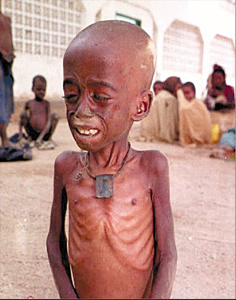
photo: The orion “Don’t waste food. The children in Nigeria are starving.” I only really understood my mum’s oft-repeated rhetoric when I saw poverty, in all its disgrace, for myself.

I was in Beijing on an exchange programme last December. One evening, as I walked down a filthy street, burying my hands away from the icy gale, in the snug comfort of my pockets, I noticed a scrawny man - with a stump for his right hand – shiver in the bitter cold in his filthy cardbox “home”. He only had a tattered (and probably scavenged) bedsheet for warmth. Hesitating, I decided he wasn’t one of those I had been warned about, and rummaged in my haversack (chock full with cheap shopping) for some shirts to offer to him. The gratitude in his eyes pierced my conscience. Hopefully, they would keep him warm.

Born into prosperity - and all its luxuries - I consider myself blessed. I know not what it is like to be poor and hungry. All I know it that it isn’t nice – and that that’s an understatement.


The root of dystopia

Looking at the affluent first world, capitalism seems to work as an economic model. But it’s far from a panacea. It causes extreme polarization. 1.1 billion worldwide subsist on less than US$1 a day (see endnote 1). The very concept of survival of the fittest, which makes capitalism successful, also makes it cruel. While the fittest survive, the rest, like that disabled man in Beijing, languish. The race to riches has sidelined many.

The poor world is also plagued with a deluge of problems – ranging from political turmoil (Bangladesh) to civil war (Iraq) and even genocide (Sudan). These only exacerbate an already dire situation via direct damage and killing off what little economic opportunities there are.


Hope of a better age

It is only right that we, on the greener pasture, emerge from our selfish disinterest and help the poverty-tormented.

But throwing money at the problem won’t work. Aid is only temporary relief; it doesn’t make the poor any richer. When donor fatigue sets in, the poor are often left to rot (see footnote 2). To reap sustainable long-term benefits, on a scale much greater than what aid can do, the poor must stand on their own two feet: they need to sort out their domestic bedlam, and develop their economy. Education is key to escaping the poverty cycle.

We should help them along. Micro-credit to the poor, as Yunus has done, is one good way to give the poor opportunities to move up the economic ladder, and kickstart the third-world economy. It would be sad if others extend micro-credit as a profiteering business – every single cent should go to the poor, not into someone’s fat wallet.

Yunus deserves his Nobel. If only others could follow his example – especially those politicians and farmers who sabotaged the Doha trade talks with their selfish demands.

The children in Nigeria deserve better. They’re humans too.


You too can help eradicate poverty. Click here.

--------------------------

English online blog of personal response to current affairs.
Portfolio submission 1 for Term 1

Nigel Fong (3C / 6)
19 February 2007

Word count: 499
, excluding endnotes & bibliography.


Endnotes & Bibliography

1. Glossary. The World Bank. Retrieved 20.2.2007, from http://www.worldbank.org/depweb/english/beyond/global/glossary.html#52 Click here

2. A good background reader on and example of donor fatigue: Purtill, Corinne, (2005). Charities fear ‘donor fatigue’. Retrieved 20.7.2007, from http://www.azcentral.com/community/tempe/articles/1012ev-needs12Z10.html Click here

3. Update: The economist article ends by acknowledging rumours that Yunus might enter politics. These rumours turn out to be true. Yunus has formed a political party and entered Bangaladeshi politics. He is a welcome addition to Bangaladeshi's chaotic politcal scene, dominated by 2 women perpertually at loggerheads. There are fears, however, that he might succumb to the corruption that pervades Bangaladeshi politics. Further reading

Personal response to "Stop stop the chop chop"

Original article:

Category: environment
Brazil proposes a fund to reward developing countries to cut their rate of deforestation. Others regard trading “avoided deforestation” certificates as carbon-credits as a better alternative.


Stop stop the chop chop: Trees and how to save them

Nov 2nd 2006, from the Economist print edition.
Also available online with a subscription. Click here


FEW things on earth seem as defenceless as a forest. To many people, it is worthless unless harvested for its trees or destroyed to create farmland. Tropical forest is vanishing at a rate of 5% a decade, wrecking habitats and releasing 3 billion tonnes of carbon dioxide a year, a fifth of global greenhouse emissions.

Most tropical forest is in poor countries, so giving it monetary value may be the best way to save it. Efforts to do that are accelerating. At a United Nations meeting on climate change in Kenya next week, Brazil is expected to propose a fund to reward developing countries that cut their rate of deforestation. This is a change of heart: till last year, Brazil had resisted the idea of taking cash in return for keeping trees intact.

Brazil's idea relies on contributors' goodwill. The only penalty for countries that cheat would be the loss of future incentives. Some think it might be better to trade certificates in “avoided deforestation” in the global carbon-credit market, through which polluters in rich countries can pay others to reduce emissions.

The economic value of chopping down trees varies widely, the World Bank notes in a new study. Pasture in the Amazon is worth as little as $200 a hectare. At the current price of carbon credits (which is volatile) the same area of dense rainforest would be worth around $7,500, says Kenneth Chomitz, the report's main author. So the gains from clearance are often much less than the cost to the planet of the carbon released by burning or rotting trees. Thus it may make sense for rich polluters to pay, via the market, for the forests' upkeep.

Sceptics say “dumping” forests on the world's carbon market would lower the price, thus reducing the incentive for rich countries to use greener power—unless emission targets were toughened, which would tighten the market. Other greens say countries should be paid for providing “eco-services”—like biodiversity—and not just for avoiding destruction.

But even if the effect of “cash for non-deforestation” is short-term, it is worth having: it could buy time to develop non-fossil fuels.

In any case, Brazil is already making progress. Deforestation in the year to August dropped 30% to 13,000 square kilometres (5,000 square miles). Last year's fall was similar. One (changeable) factor is a strong currency, which depresses prices for farm products. IPAM, a think-tank, also credits tougher state action against land grabbing and corruption.

All this will boost Brazil's case as it sets out to convince other countries it can reliably deliver exactly what they say they need—intact forests.

------------------------------

Personal response

photo from this page , source uncertain

Humans have imposed a plethora of changes on our planet. Transforming barren land into prosperous is sensible; but relentless, short-sighted development has had its ramifications on the environment – 80% of the Earth’s natural forests have been destroyed (see endnote 1). It is a question of finding a balance.


It’s the economy, stupid (see endnote 2)

Chopping trees down and selling their wood is quick and easy money. I do not blame the poor and hungry when desperation forces them to do so to fill their grumbling stomachs – and that of their children. But the greedy (like big logging companies) who deforest in astronomical volumes to fatten their wallets should be condemned. I may not fully understand the unique situation of some, for whom there is no alternative livelihood to logging, but all I can say is this: don’t be greedy.

We, at the other end of the wood trade, are also to blame. It is our insatiable demand for paper and wooden furniture that makes the tree-killing business so profitable and attractive.


We ought to do better

Considering that forests are a pillar of our very existence, blessing us with oxygen, fertile land, wood, and much more, removing them is illogical and shocking. All that deforestation for short-term material benefits has long-term consequences.

And utility isn’t the only impetus to conserve. It is selfish and egocentric to regard the forests as our own property (hence we have every right to do as we please with it, as the argument goes). No. Forests are the common property of past, present, and future generations of all living things on this earth. Morality dictates that we avoid depriving others – including our descendants – of this vital resource.


Light at the end of the tunnel

I am no expert in this, but I feel a fund to reward developing countries that cut their deforestation rate and trading “avoided deforestation” certificates as carbon credits (see endnote 3) are both feasible solutions. Here’s how they work:

The economic inconsistency fundamental to deforestation is this: the value of trees is intangible; hence they don’t have an attached monetary value (a “price tag”). In terms of dollars and cents, trees are free – hence the incentive to cut them down and monetize them.

Both solutions would address this economic inconsistency by attaching a monetary value to trees (you have to pay to deforest). Hence economic self-regulation can occur: making deforesting more expensive reduces the profitability to deforest, hence less deforestation occurs, and wood products become more expensive, reducing demand. All in all, less trees will be cut down.

At the very least, these proposals are a step in the right direction, indicating a newfound commitment to overcome the collective action problem (see endnote 4) and stop deforestation.


Is it too late?

We often take things for granted – until it is too late. Hopefully, it isn’t too late to save the trees, but we must act immediately, for, with each ticking second, we are more likely to have crossed the path of no return.


--------------------------

English online blog of personal response to current affairs.
Portfolio submission 1 for Term 1

Nigel Fong (3C / 6)
19 February 2007

Word count: 498
, excluding endnotes & bibliography.


Endnotes & Bibliography

1. Forest Holocaust, (n.d.). Retrieved 17.2.2007, from National Geographic: http://www.nationalgeographic.com/eye/deforestation/effect.html Click here

2. Phrase originates from Bill Clinton’s successful 1992 US presidential campaign against George H.W. Bush.

3. See Kyoto protocol for background information on carbon credits

4. Collective action problem (background information): When the benefits of doing something are dissipated among everyone, but the cost is concentrated on one party, there is no impetus for that party to carry out that action. This results in a lot of foot-dragging. A perfect example of this would be the crazy amount of foot-dragging by nations in solving global environmental and trade problems. The collective action problem is overcome when the detriments of inaction are so severe that all parties involved get together and act collectively.